
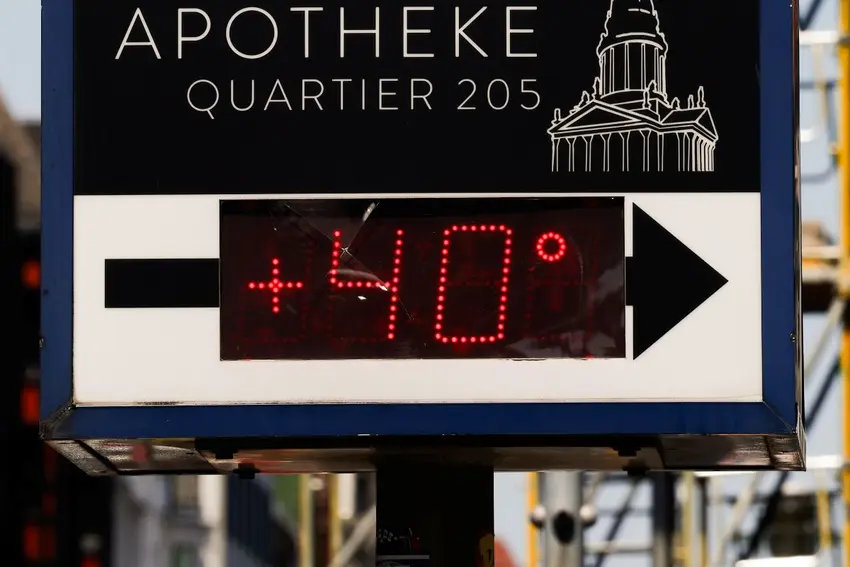
Back-to-back heat dome events are killing people in Germany at an unprecedented rate this summer, yet leaders in the highest positions of the federal government have said almost nothing about it.
Up until August 2nd, heatwaves across Germany have led to an estimated 12,500 deaths this year, according to the Robert Koch Institute (RKI) public health authority.
That’s already well above what is usually seen in an entire year – even for other particularly hot years. The RKI notes that its figures are conservative estimates, and that the true number of heat-related deaths in Germany so far this year is likely higher.
Notably this fact has not triggered any noticeable alarm from Germany’s current conservative-led federal government. In fact, Chancellor Friedrich Merz has barely acknowledged it.
Asked about the issue at his summer press conference in mid-July, Merz said he would “continue to monitor the situation” in the coming days and weeks”, and if necessary, “say something about it publicly”.
Several heatwaves, and several thousand additional heat-related deaths later, Merz has remained quiet on the issue, as have most of his colleagues in the cabinet.
Extreme heat events are becoming more common, more intense and more lethal as the climate warms due to greenhouse gas emissions.
Last week thousands of demonstrators gathered in front of the Federal Chancellery in Berlin to call on the government to address the situation, and take action for climate protection.
German climate activist Luisa Neubauer criticised the government harshly in a speech she delivered at the rally.
If another catastrophe had claimed so many lives, Neubauer said, "heaven and hell would have been in motion". She called out Chancellor Merz in particular, saying that the fact that 12,000 heat deaths "are not worth a single word to him is shameful".
Meeting targets on emissions
Germany’s Constitutional Court ruled in 2021 that the federal government is responsible for carrying out the country’s climate protection plan.
This means that the government needs to make efforts to meet certain greenhouse gas emissions reduction targets in the coming years; targets which many critics say are too weak to begin with, and which are yet to be met in the transportation or housing sectors.
READ ALSO: Germany set to miss 2030 climate goal
At the same time Merz has personally pushed for some policies that work against the country's climate goals, such as watering down the EU's electric vehicle mandate and the heating law which was meant to make home heating less dependent on fossil fuels.
Meanwhile when it comes to protecting citizens and residents from extreme heat and related severe weather events, that responsibility falls on the states and municipalities.
What’s being done?
The German Environmental Aid Association (Deutsche Umwelthilfe - DUH) monitors cities’ heat ‘preparedness’ as well as their adaptation efforts as part of its annual “Heat Check” report.
In particular DUH notes that planting more trees, and unsealing paved areas are two of the most immediate actions cities can do to reduce heat stress for their residents.
But in many cities, the opposite is occurring on both fronts: Germany is losing trees overall, in part thanks to hotter and drier conditions linked to climate change, and many cities are also continuing to pave more areas as they expand outwards.
A spokesperson for DUH told The Local in an email: “We currently view the political will to reverse this trend as completely inadequate.”
They added that laws and projects brought by the federal government, including the "construction turbo" policies are actively leading to a loss of trees and increased surface sealing.
On the other hand, in some select cities projects aimed at building climate resilience are moving forward.
The DUH spokesperson cited the Berlin Tree Referendum, and the resulting Berlin Trees Plus Act as one of the most far-reaching projects nationwide reversing the troubling trend.
RANKED: The best German cities to be in during a heatwave
The Greens call for more cooling
In the Bundestag, the Green Party has become one of the leading proponents for investing in heat protection and cooling measures, including air conditioning and especially in schools.
“This includes shaded and green schoolyards, suitable ventilation and cooling systems as well as sufficiently heat-protected recreation rooms,” said Parliamentary group vice-chairman Misbah Khan. “The burdens on students and teachers are enormous and sometimes make concentrated teaching impossible.”
Khan’s comments came as schools in Rhineland-Palatinate, Hesse and Saarland, were dealing with extreme heat brought by the fifth major heatwave in the region this summer.
Comments